
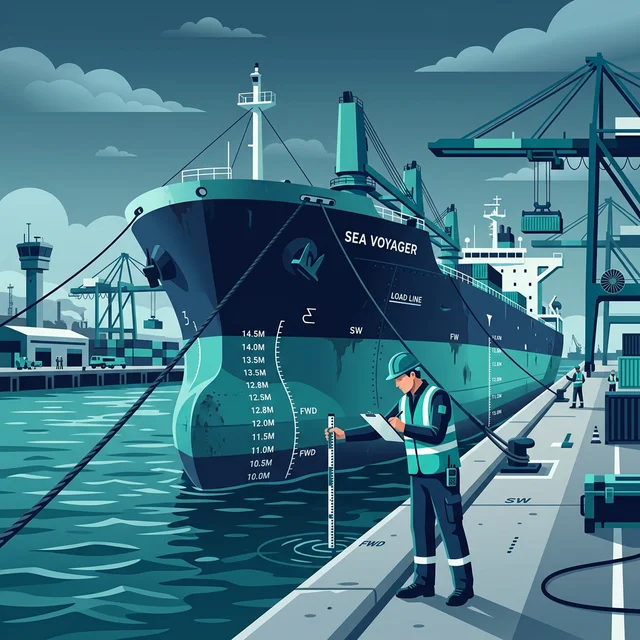
A draft survey calculates cargo weight from the vessel's change in displacement before and after loading or discharge. This guide gives the working sequence: six draft readings, perpendicular corrections, means of means, hydrostatic table lookup, water density correction and deductibles.
For quick supporting calculations, use the Mean Draft & Trim Calculator, Linear Interpolation Calculator and FWA/DWA Calculator while keeping the vessel's approved tables as the final authority.
Step 1: Reading the Drafts
Before any calculations begin, the Chief Officer and the independent surveyor must visually read the draft marks on the hull. This is done at six points: Forward Port, Forward Starboard, Midships Port, Midships Starboard, Aft Port, and Aft Starboard.
Because the sea is rarely perfectly flat, you must average the crest and trough of the waves against the draft marks. For extreme precision, a sounding tube or draft indicator may be used, though visual readings remain the standard.
Step 2: Correcting for Perpendiculars
Draft marks are painted on the hull where it is physically possible, which is rarely exactly at the Forward or Aft Perpendiculars (the mathematical points the ship's stability booklet uses). You must apply a mathematical correction to "move" your physical readings to the mathematical perpendiculars. This is based on the distance of the marks from the perpendicular and the vessel's trim.
Step 3: Calculating Quarter Mean and Means of Means
Once you have the corrected drafts, you calculate the averages. Because vessels are not perfectly rigid steel boxes—they bend—you must account for Hogging (bending up in the middle) and Sagging (bending down in the middle).
The "Means of Means" formula gives the midship draft double the weight of the forward and aft drafts to mathematically represent this parabolic hull deformation.
Mean of Means = (Forward Mean + Aft Mean + (6 * Midship Mean)) / 8
Step 4: Using the Hydrostatic Tables
Enter the vessel's Hydrostatic Tables using your calculated Mean of Means draft. This will give you the underlying Displacement of the vessel in standard saltwater (density of 1.025 t/m³).
Step 5: Density Corrections
If you are not floating in standard saltwater, you must apply a density correction based on a hydrometer reading of the water around the vessel. If the water is brackish (e.g., density of 1.015), the ship pushes less water aside, and the displacement must be multiplied by the ratio of (Actual Density / 1.025).
Step 6: Deducting Deductibles
The final displacement is the total weight of the ship and everything on it. To find the cargo weight, you must subtract the Lightship weight (the empty steel ship), the ballast water, fresh water, fuel oil, diesel oil, lube oil, and constant (crew, stores, provisions).
What remains is your exact cargo weight.
Sources and verification
Use these references as the starting point for verification; always follow current flag-state, company, port, and approved shipboard documents for operational decisions.
Tired of manual interpolation errors?
CaptainCalc automates the entire Draft Survey process. Input your raw readings and let the app handle the perpendicular corrections, hog/sag averaging, and density modifications instantly.